Jump to Pt I Jump to Pt III
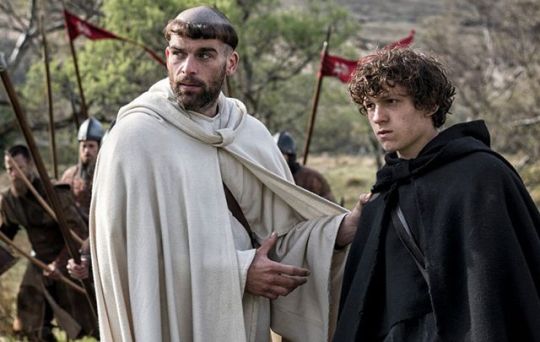
After examining the purity of heart exemplified by Brother Diarmuid, I want to take a look at the character who serves as Diarmuid’s most direct foil, Brother Geraldus (left). Geraldus enters the film appearing to be a man of faith. He is a Cistercian monk, an order following the ancient pre-Schism teachings of St. Benedict of Nursia. He also seems to be well educated in the history and workings of the Church. For all this, however, there is a disconnect between his word and his action. He does not display the integrity that the Irish monks embody, especially that of Diarmuid. His fatal flaw seems to be a kind of hubris, and a lack of love for the Other. Geraldus thinks he knows God’s will at all times, that God desires to crush “infidels”, heretics and all who oppose the sociopolitical will of the Catholic Church. More on this later.
Early on in their journey, the monks encounter a brook where Geraldus wishes to draw water. The locals warn him that it contains a fairy fort, and that those who drink the water may be cursed by the fey. Geraldus berates the Irish monks for supporting this “superstition” and performs an on-the-spot exorcism, casting out “demons” from the water in the name of Christ. In the context of humble faithfulness, this could be a positive action. However, it is done with a disdain for the lived experience and wisdom of both the local laity and Geraldus’ traveling companions, the Irish brethren. Furthermore, even at this early stage Geraldus displays his very rigid, fundamentalist understanding of faith. Anything that gets in the way of his goals (in this case, drinking the water to prove a point/prove his superior wisdom/constitution) is an enemy of Christ that must be destroyed. He upholds this militant Christianity to stroke his own ego, rather than praying in true humility and in fellowship with those around him. Later, it turns out that the stream is in fact polluted by the corpse of a dead animal further up stream. Brother Diarmuid offers healing herbs to everyone who drank the water, and the crisis is averted. This scene is not written to an ideal payoff, but there is an implication that Geraldus’ pride almost gets the party seriously ill. The Irish monks, by contrast, trust the inherited wisdom of their community and that all truth is God’s truth.
When the monks make camp with the Normans, Geraldus has a conversation with Brother Ciaran about the intentions of their new benefactors. Ciaran is very wary of partnering with these warriors from the mainland. “Surely, you are under no illusions as to what kind of men these are,” he tells Geraldus. Geraldus’ fundamentalist hubris is unable to see the wisdom in Ciaran’s caution. Indeed, Geraldus goes as far as to offer a kind of clerical blessing on the violence and conquest of the Normans. He tells Ciaran that these men need someone to intercede on their behalf at the Judgment Day, to bless them for the blood they’ve shed. In a sense, he excuses the sin of violence when he believes that it serves the greater purposes of the Church (to drive out pagans and heretics from the British Isles). A healthy theology of grace suggests that the authority entrusted to clergy is an extension of the grace of God which seeks to heal human brokenness and make all things new. Geraldus sanctioning bloodshed is a cheapening of grace, not only in terms of honor, but in terms of purpose. It misunderstands that grace is not merely forgiveness, but light and life which drives out the darkness of sin, violence and hatred. For “God is light, and in Him there is no darkness at all.” (1 Jn. 1:5).
We’ve already talked in the last section about Geraldus’ priorities when the brothers go to rescue Ciaran. As mentioned before, the sign of God’s power and the church’s authority in the relic is more important to him than the living icon of God, Geraldus’ human brother in faith. This again reveals an interest in the forms and trappings of spirituality without an investment in the true heart of it. It is missing the forest for the trees.
Towards the end of the film, Geraldus’ true nature is revealed. It is discovered that his father was condemned as a heretic, and Geraldus oversaw the preparations to have him burned at the stake. Geraldus shows no remorse for this heinous act throughout the course of the film that remains, saying that he did his duty to God and the church, and that heretics deserve no mercy. To him, God is not interested in love or mercy but in conquest, which is of course a fundamental misunderstanding of Christ who came “not to be served, but to serve” and who offered Himself up for the life of the world, trampling death not by murder but by His own death.
In the end, as mentioned before, Geraldus forces the Mute to shed blood on their behalf. He does not see this as an unfortunate necessity, but delights in it, rambling to Diarmuid about the coming conquest of the Church over the world. He is impressed by power and thinks that God is as well. The deathly nature of pride is illustrated very literally at the end of the film when Geraldus falls into the sea pursuing the relic, the instrument of power which would give him and the church the strength to conquer. Diarmuid, by contrast, values life, and is willing to relinquish all power if it will end the bloodshed that the relic has wrought. Geraldus’ role is a cautionary one, that pride often drives self-righteousness and the judgment of others. Whenever our religion and faith seem to be more focused on externals and the appearance of holiness rather than humility, gentleness and the fruits of the Spirit, we are in a state of spiritual illness. Instead, we should focus on Christ, and on His greatest commandment, to love the Lord our God, and to love our neighbor as ourselves.
Tuesday, June 25, 2019
Monday, June 24, 2019
"Giving It Back to God" -- Models of Faith in the Movie "Pilgrimage" -- Pt I: The Pure In Heart
So this is hopefully going to be a short series of essays looking at faith as it is portrayed in different archetypal ways by the main characters in the 2017 Irish film, “Pilgrimage.” If you haven’t seen it, go check it out. It’s fairly bloody, but emotionally and theologically rich. And it has Tom Holland in it, so that’s a plus.
If you haven’t seen the film, the premise is roughly as follows (Spoilers): a group of Irish monks in the 13th century are visited by a French Cistercian monk, who charges them with orders from the Pope to bring the monastery’s relic (a stone which was used to kill St. Matthias) to Rome. Along the way, they must deal with (eventually treacherous) Normans, Celtic brigands, and the gradual erosion of the Cistercian’s character. For this first entry, I want to discuss Tom Holland’s character, Brother Diarmuid, a young novice who serves as the film’s primary protagonist/point of view character.
In Matthew 5:8, Jesus says, “Blessed are the pure in heart, for they shall see God.” This “purity of heart” has a few different complimentary meanings. In the first place, it means an absence of evil intent or tendency. But in the broader context of the Gospel according to St. Matthew, “purity of heart” and “perfection” often have to do with a kind of consistent integrity. The idea is that the believer is encouraged to form intention and action into a unified whole. Rather than being double-minded, doing one thing while saying or thinking another, Christ desires that the heart, mind and hands are unified in thinking and doing good. There is precedent for this in the Jewish Scriptures as well. Compare, for instance, “Love the Lord your God with all your heart, all your soul and all your strength” (Deut. 6:5).
More than most characters in the film, Brother Diarmuid embodies this kind of integrity. Early in the film, Diarmuid asks his mentor, Brother Ciaran, if there has ever been peace in the Irish lands, before the coming of the Normans. Though Ciaran says no, it’s clear that he is not dismissive of Diarmuid’s question. Diarmuid truly embraces the spirit of monastic life, not to be a sacred accomplice to war or violence, but to “live at peace with everyone, so much as it depends on you” (Romans 12:18). He does not desire that the Church gain political power, but that the isles might live in peace and harmony. His desire reminds one of the words of St. Seraphim of Sarov, “Acquire the spirit of peace, and thousands around you will be saved.”
When the elder monk, Brother Ciaran, is captured by brigands along with the relic, Geraldus (the Cistercian) opines that they only have time to save the relic or Ciaran, but not both. Geraldus insists that Diarmuid save the relic, but Diarmuid instead goes directly to cut Ciaran free from the post where he is tied up. While this is certainly an act of love towards his mentor, Diarmuid’s choice also reveals an understanding of holiness. The relic is meaningful not as an abstract container of divine power, but because it serves as a reminder of the witness and holiness of St. Matthias, of his faith in the gospel to the end. Likewise, holiness in this moment is not saving a cultic object (valuable though it may be), but living the holiness of the gospel (preserving life even at the cost of valuable, holy things). Diarmuid’s priorities are to preserve life and to keep his community together against those who would seek to tear it apart for power or fortune.
Holiness is also grounded in humility. When the monks reclaim the relic towards the end of the film, Diarmuid agrees to carry it now that they’ve lost the reliquary to the brigands. Before placing the rock in his bag, he kneels and prays. There is a practical dimension to this, as the relic has been said to strike down people and that “only the pure in heart may carry it”, but I get the sense that Diarmuid’s piety is genuine here as well. There’s no words, but I imagine him asking to be made worthy to carry the stone. Diarmuid does not rush to claim ownership, to possess the relic as others in the narrative do. Rather, he accepts the responsibility of bearing it “with fear and trembling” and asks for God’s help to handle it responsibly while it is in his possession.
This humility pays off at the end of the film. Geraldus has whipped up the Mute, a presumed former Crusader traveling with them, into a blood frenzy. The Mute goes to do battle with the monks’ enemies, perhaps seeking to atone for his sins. As the monks row away from the shore, the Mute sacrifices his life to save them, and one of the monks, Brother Cathal, has been shot by an arrow. Geraldus seems unfazed by this, and begins to wax poetic about how the relic’s return to Rome will signify a new age of conquest and holy war against the “heretics and infidels”. Brother Diarmuid realizes that the relic cannot be allowed to fall into the hands of the Roman church authorities. Whether its power will serve them or not, the sense of self-righteous xenophobia displayed by Geraldus and his kin will only be heightened when they possess a legitimizing apostolic relic. The relic has protected the Irish monks during times of attack, but they have never sought to conquer nations. Only to continue to love and serve God and their community.
Diarmuid reaches for the rock. Geraldus warns him, “The relic belongs to God.” Diarmuid responds, “I’m giving it back to Him,” and after a struggle the rock is thrown into the sea, causing Geraldus to go in after it and likely drown. Diarmuid, though not intending to harm Geraldus, understands that the power represented by the relic will corrupt the purity of his church’s faith. Rather than being an asset to the witness of the gospel, it will serve as a symbol of pride and disdain for those seen as “lesser than.” And no relic, no matter how sacred, is worth that cost. Diarmuid knows this, because he is deeply in touch with what it means to be a man of faith. He is a novice in the monastic order, and knows little of scholastic theology. But he shows love for his kinsmen, and a deep intuition of what God desires of humanity. Whenever he acts, he refrains from violence where possible. Where situations force him to use violence, he uses it only to protect, and there as little as possible.* In all things, his intention and his action flow into each other, and all for the purposes of love and for peace. He is one of “the pure in heart” and at the end of the film, the final shot reveals a quasi-celestial light shining through the Irish cloud layer on Diarmuid’s boat. It seems that in the film’s language, he has indeed, “seen God.”
*Note: We will talk more about monasticism and absolute nonviolence later, in my essay on Brother Ciaran. For now, it suffices to say that Diarmuid eschews violence whenever possible, and only acts in self-defense with non-lethal force in the instances he does fight.
Wednesday, June 5, 2019
Pedagogy, Mystagogy and Orthodoxy in the Modern Era: A Brief Hot Take
Note: This is adapted from an introduction I wrote to my practicum project, which is a Lenten teaching curriculum for Orthodox Christian adult laity in a “Sunday school” or devotional context.
In the present time, there is a need for more in-depth educational resources for adult lay learners to deepen their understanding of Orthodox Christian faith and praxis. I say this not as an alarmist. I am not concerned about “encroachment” from ecumenical dialogue, nor am I worried about congregations being “led astray” by priests who in pursuing the creative spirit of Orthodoxy sometimes forgo the “letter of the law” that an overly rigid interpretation of the canons demands.
I notice this need rather as a convert to the Orthodox Church who often feels that our pedagogy is lacking in two areas. First, there is a lack of interest or familiarity with the practical theology of our tradition. As a convert, I was invested in understanding what makes Orthodoxy unique, how it coheres as an entire thought system and way of life, and how it can offer unique contributions to the entire Body of Christ. I felt compelled to understand my newfound faith, and the ways it could be life-giving. I want other people to be able to experience this joy I have found, and to be able to apply the riches of our tradition to their own lives. I try to make my writings and work accessible, but I believe that laity are capable and in need of a deeper understanding of these currents of our faith.
Second, I feel that there is often a lack of willingness in Orthodox pedagogy to engage with modernity. There is some understandable cause for skittishness. As Orthodox Christians, we place a high value on Holy Tradition, and the preserving of the good things that have been handed down to us from the undivided Church and from our later Eastern Christian heritage. In the midst of certain modern Christian distortions of a vibrant Christian faith (prosperity gospel teachings, fundamentalism, white supremacist “Christian” movements of all stripes), there is certainly value in holding on to what is good. But good teachings can only serve God’s good purposes if they are able to meet the challenges modernity brings. And no set of ideas can meet a challenge it is not made to face. We are told to trust that our faith and tradition is able to stand the test of time. It is my hope that Orthodox teaching in the present can be made to engage creatively with modernity, in hopes that the wisdom of God’s saints will be able to offer enlightenment and perspective on the matter. This includes engaging ecumenically with non-Orthodox theologies and resources, and at times applying what is useful within them to the already rich system of Orthodoxy. In all things, an attempt should be made to take an irenic tone that is “seasoned with salt,” while also making no peace with the systems of sin and death (both individual and collective) which pervade human society.
Thursday, May 30, 2019
Theology, Math and Logic, Pt I: Is Theology a “Calculus” or a Science? (A Brief Hot Take)
I wanted to share some thoughts that have been swirling around in my head about ideologies and thought systems that may have relevance to the conversation on theology. This stuff is fairly ethereal and I am not an expert in mathematics, modern philosophy or formal logic*, so I may butcher definitions. Bear with me.
So the other day I was talking with an old friend of mine who I had just recently gotten back into touch with. He’s a computer scientist and was describing to me what (to me) seemed like a very esoteric but useful system of mathematical theory (homotopic type theory, where you visualize sets of things as “paths” on an imaginary map and measure them by how they overlap and connect to each other). In laying out the principles of this theory, he used an approach that felt to me much more grounded in logic than in math equations per se, going principle by principle until he had more or less built up the concept in my mind.
I described to my friend how his process of laying out an ideology felt very familiar to me. It sounded like the way some people talk about theology, laying out core principles and trying to build on them in a “systematic” way. Sometimes this works and produces a theological system that’s elegant and beautiful. Sometimes it produces a system full of contradictions. Sometimes it produces a system that has all the right moving parts but it’s hard to imagine why anyone would find it appealing or helpful. What intrigued me was the differences in approach between doing this in theology and doing this in math or other fields.
I began to try and think about whether theology is more like math or more like science. There’s a great video by Youtuber Vsauce about numbers beyond infinity.** In it, he briefly discusses how in science, your assumptions are based on assumptions about how the world works, and must be modified to most closely match the observable physical universe. In math, by contrast, all that needs to happen is that your assumptions are logically consistent and that they don’t contradict themselves. Math can “create” systems that cannot exist in the physical universe but which still work from a mathematical standpoint because they are consistent.
We use “calculus” to sometimes refer to not just the math system, but metaphorically to a way of thinking that is built on math-like prepositional logic (“If A=B” etc). A question comes to my mind: is theology a “calculus” or a science? And why does it matter?
When I talked to my computer science friend about my theological studies, I framed it as a kind of calculus. I talked about how in the absence of an empirical mode to “verify” our understanding of God within the physical universe, theology must be more of a math than a science. I admitted that as a result of this phenomenon, I often evaluate theologies less by whether they are “true,” but by whether they help people live more well-adjusted lives, as well as how well they mesh with my understanding of God. On an objective level, I think probably most of our ideas about God and none of our ideas about God are true. This is not to say I’m a relativist, just that the Creator of the universe is going to by nature be so far beyond our comprehension that we will necessarily get things wrong. I don’t see this as a problem because we can still cultivate a loving relationship with God. On the other hand, the work of the Christian mystics, as well as the existence of a Bible with at least some historically verifiable events suggests that there are “science” elements of faith. The disciple is, in a sense, both a kardionaut and a field researcher, exploring the depths of their heart and the heart of God, as well as discerning how God is active in the world. Math also doesn’t know what to do with paradoxes, but the Gospel and faith delight in paradoxes. There is so much about the both/and. Truth and grace. God and human. Already and not yet. Foolish wisdom and wise foolishness. In that sense, theology is more like the science which observes light as both a particle and a wave. It’s also more like art. The student of theology can make radical moves with their “colors” on the canvas, mixing and combining palettes in unexpected ways to approach a portrait of the great Subject, God. Like a poet, they write and revise words in an attempt to come closer and closer to the image of God, an image which can be approximated but never fully captured except in the person of Christ.
I think when people judge other people’s faith (especially within the same broad religious tradition), they’re operating under the assumption that theology is a science and the other person is doing it wrong. In a pluralist society, I wonder if the truth of the Gospel might be communicated more effectively if we allowed the pure light of God’s love to be filtered through the lens of people’s experience. Corrections may need to be made along the way, but if we think of the pursuit of God knowledge as more of a calculus by which we come to a way of life and discipleship that encourages our own unique flourishing under God, and less as a set of highly specific truth claims that must be defended at all costs, we might be better off.
On the other hand, it’s possible to lean too far into this thought pattern and to ignore both the witness of the Gospel and the ways in which God does tangibly “show up” in our lives. When academic theologians construct thought systems which read prettily off the page but which do not account for God’s capacity to surprise and challenge us, then we need to remember that God does promise to show up in our lives, to be attentive to the “science” of the heart.
*Nor, by the patristic/matristic definition am I truly a “theologian” (one who is able to speak about God from intimate direct experience a la St John or St Gregory Palamas), but I am at least a student of theology. **Link https://www.youtube.com/watch?v=SrU9YDoXE88
Sunday, May 19, 2019
Eco-Martyrdom Pt I
As I look at the projections about how much time we have to reverse catastrophic climate change (the number circulating around is roughly 12 years), I find I am often moved to despair. The ongoing slogan is “let this radicalize you rather than lead to despair”. While that’s an admirable sentiment and probably helpful for a lot of people, I’ve been wondering about how people can participate in/be motivated to activism when they, like me, are overwhelmed and in a state of despair/helplessness at the magnitude of the task before us to try and save the planet.
Paradoxically, I find what’s giving me comfort is the idea that maybe I can’t save the planet. Maybe we can’t save the planet, though we sure as hell ought to try. I often find a way for me to deal with despair and anxiety is to go through the worst case scenario in my head, and come up with some kind of contingency plan for that. I figure that way, I’m prepared for all possibilities, and if things go better than the worst case, so much the better for me/everyone. As I confront the possibility that we as humans may not be able to save the planet/ourselves, I am moved to consider what mindset will help me to take action.
And more and more I am moved by the early martyrs of the Church. Contrary to popular opinion, most of them (with the possible exception of St. Ignatius of Antioch) did not want to die. They held on to life for as long as possible, and served in the Church as leaders, teachers, priests/shepherds, theologians, etc. But when they came under pressure from the Roman authorities, they did some soul searching and determined that they would rather stand up for their beliefs and way of life, and be remembered as people who did what was right, rather than capitulate to Rome and possibly save their physical lives (βιος), but lose the vitality and wholeness that gave them true life (ζοη).
With the world possibly literally ending (at least for human flourishing), now seems as good a time as any for me and perhaps others to switch from a metaphor of conquest by the success of our efforts to victory by the character and faithfulness of our efforts. I’ve heard various people I know rightly complain that “the brunt of the damage is being done by a handful of companies, and since they won’t change, how much good can I do?”. While this is true, it reveals a bigger problem with activism for some of us: our energy to engage is sometimes tied to whether we can reasonably expect success. I want to consider other ways to move people to righteous action, particularly in this sphere where the prognosis is grim.
I recall often that the Greek word “Martyr” (Μαρτυρια) means “witness”, someone who proclaims the Truth of Christ by their actions, words and character. Sometimes martyrs die, and sometimes they survive, but what matters most is that they do everything they can to be on the right side of history and (for those of religious faith) spirituality. I find much more hope and resolve to engage with climate change activism if I think of myself as an eco-martyr, someone who is called to witness to the harm that has been done to God’s creation that They called “good”, and to do whatever I can to heal it. I may die in the attempt, but in the end I feel that even if we as a species fail to save the planet/humanity, I would rather know myself as a martyr, someone who witnessed to the Truth of his God and his world, until my last breath.
Eco-Martyrdom Pt II -- Activism and the Resurrection
Quote from Fr. John Meyendorff: The Ethics of Resurrection:
“Is it not true that our mortality serves to justify our concern for ourselves, instead of our neighbors? My neighbor can be cold and hungry next door, but I feel quite justified in preserving my own standard of living and the security of my own future, because I consider my money as having been earned by me (or given to me) with no other purpose than to prolong my own life and to make it as comfortable as I can.
Moreover, even the laws of this mortal world of ours are made in such a way that their main purpose is to preserve my rights and my property. They justify violence as a form of self-defense. And the history of human society is one of conflicts and wars in which individuals and nations struggle and kill others in the name of temporal benefits which will be destroyed by death anyway. But this is still considered as “justice.”
Such is, indeed, the inevitable logic of a world, which St. Paul describes as “the reign of death.”
On Easter Day (Pascha) however, we celebrate the end of this reign. Christ came to destroy it. "Death is swallowed up in victory, O death, where is your sting?” “Christ is Risen, and no one remains in a tomb” Therefore, as the Church sings, “let us embrace,” “let us forgive.”
This victory which our Church celebrates so brilliantly, so loudly, so triumphantly, is not simply a guarantee of “after life.” Rather, it changes the entire set of our ethical priorities, even now. There is no need for self-preservation anymore because “our life is hidden with Christ in God.” To love one’s neighbors and to give them the "last penny” is better insurance than to “store treasures upon earth.” “To lose one’s soul” is “to save it."”
I’ve been turning over this little meditation by Fr. John in my mind for the last few weeks, as I consider some follow-up thoughts to my previous piece on Eco-Martyrdom*. After reblogging another post proclaiming the need for environmental activism to counteract the devastating effects of climate change (specifically in the form of direct action and forcing governments to make changes), I felt once again that despair. I still believe in the idea that I want to witness to the truth of care for God’s creation no matter the cost, but I couldn’t help thinking that, as things get worse, it’s going to be harder and harder to summon up the will and comfort with discomfort necessary to do so. Many of us, myself included, are tempted to be overwhelmed and just try to look out for ourselves because throwing our weight behind collective action and sacrificial acts for others is often exhausting and can be dangerous.
It was at this moment that I remembered this meditation, and I thought perhaps it could be of help. What if this ecological crisis is really what will test our faith in the Resurrection and its ethical implications? Christianity has been corrupted at times by many forces outside and inside the Church. Many of us have been taught to believe a lie that “resurrection” just means that our soul keeps living in a disembodied Heaven when we die. We are encouraged not to worry about what will happen to this world, because we will be preserved with Christ far away from this sinful Earth. We will be “raptured”, or simply die and “go to Heaven.” In extreme cases, this leads to some fundamentalist groups cheering on the destruction of our planet, God’s creation, in hopes that it will artificially hasten the Second Coming of Christ to take us away. This is a fundamental misunderstanding of eschatology, and of the doctrine of the Resurrection itself. The teaching of the early Church is and remains that we are being resurrected in our *physical* bodies, here on this earth. The funeral service in the Orthodox Church talks about the *severing* of the link between body and soul, as something that was not meant to be. Death is an interruption in our integral unity, and one that will eventually be undone. Yes, the Parousia, the Second Coming will bring about a restoration on this Earth and the fulfillment of all things. But it is still a real, physical homeland, not a disembodied, separate ethereum, that we are being called to prepare for the Kingdom of God upon. In the words of Metropolitan John Zizioulas, we are called to be priests of creation, offering up all of the world in reverence to God, not destroying and tainting it for our own sinful use.
But even if we discount Rapture theology and the neo-Gnosticism that separates creation from spirituality, flesh from soul, the difference between a “pie in the sky” quietism and a grounded faith centered in the Resurrection is rather like the difference between negative nihilism and positive nihilism. The negative nihilist** says, “There is no inherent meaning. Therefore, I will pursue self-interest and destructive impulse because nothing matters.” The positive nihilist says, “There is no inherent meaning. Therefore, I will do my best to make a good life and help others to do the same, because nothing matters except that which we make matter.”
Likewise, the religious escapist says, “I’m going to be resurrected in the Kingdom, therefore, why should I care if the world burns around me,” while the Christian “nihilist” (or perhaps the Christian “existentialist***”) says, “I’m going to be resurrected in the Kingdom, therefore, I have no need to pursue self-interest. I am safe, and will use my time in this age to do whatever I can to keep other people safe.” If we lose our physical life, we know as Christians we will receive it again. Therefore, perhaps this can be a foundation for our ecological kenosis, for laying down our comfort, security, and perhaps even our lives to help others care for our ailing ecosystem.****
**There’s probably a more descriptive philosophical term, but bear with me
***See the work of Zizioulas, Nikolai Berdyaev and perhaps also Kierkegaard
****Note: Dying for one’s faith is very different from killing for one’s faith, the latter of which I as a Christian cannot condone. It’s also important to note the element of true martyrdom in this last point. The point is not to desire death, but to not let the fear of death be a deterrent to doing what’s right.
Update: Cross-Posting
Hi all,
As a note, I will be cross-posting some content from my Tumblr blog(s) for the future. I'm fairly active on there, but I know not everyone is on Tumblr and I realized that since I write a lot of theological things on that platform it makes sense to start putting them here as well.
Subscribe to:
Posts (Atom)

