Saturday, July 27, 2019

The Flavor of Modern Orthodoxy: A Brief Hot Take and Rebuttal Of Met. Neophytos


So…Bishop Neophytos of Morphou, a bishop in the Orthodox Church of Cyprus, has recently been making the news for some ill-informed and frankly bizarre remarks on the origins of homosexuality. I’m not going to link to the articles in question, as I don’t feel that His Eminence needs a platform on this blog. Briefly,   the bishop said that when the woman enjoys anal sex, “a desire is created, which is then transmitted to the unborn child,” (this “desire” being homosexual or bisexual orientation*). These remarks make for a good sound bite, and are, quite frankly, baffling. It’s easy to make a whole article (and many news outlets have, most of whom having only a passing knowledge of Orthodoxy) out of the debacle. However, as an Orthodox Christian myself (though not one under the Church of Cyprus), I feel compelled to…I guess contextualize the situation we’re in that leads to remarks like this, to the best of my ability, and ask the more interesting question, “Why do some modern Orthodox hierarchs seem to be stuck in this kind of thinking about contemporary social concerns?”**

Eastern Orthodoxy in the New World is very slowly being forced to grapple with the demands of modernity. A lot of people (particularly non-Orthodox Christians) are just saying “They should change with the times,” and I think that’s certainly true in the sense that we need to consider the effects some of our official doctrinal positions on social issues (prohibition on women’s ordination, same-gender marriage, not much space for trans people) and adjust them so as to better care for all of God’s children, to recognize the unique gifts of everyone to the Church, and to witness a gospel that is truly Good News. But part of Orthodoxy is an emphasis on sacred tradition, and preserving what is valuable and life-giving from the words of holy people who came before and shaped the Church to what it is today. This can be a double-edged sword, of course, but part of the reason pursuing social justice in Orthodoxy is complex is because many Orthodox churches are worried that changing means not only changing their stances on things (which many laity and some clergy are open to doing), but also “reforming” and modernizing in the way that some Protestants have, in a way that cuts them off from their history, their unique “flavor” of spirituality and witness to Christ in the wider Christian Church.

TBC, i’m not saying that being non-affirming is essential to that tradition, but the question for American Orthodoxy in particular seems to be, “Is it possible to improve our approach towards social concerns in a way that is authentic to our identity and makes use of the beauty of holy tradition, rather than making Orthodoxy into a copy of Protestant churches (not that Protestantism is bad, it’s just different)?” The American churches seem to be split between, “Yes, there probably is a way, let’s figure out how” (much of my theological reflection these days is directed towards this question, as someone who has a deep love for what is beautiful about my faith, and who also sees the flaws of its institutions and where it has failed to live out that faith in justice and mercy) and “We shouldn’t have to change, secular/non-Christian society is wrong,” which, given the memory of oppression under the Soviet regime (for Slavic Orthodox communities) the Ottoman Empire (for Greek and Middle Eastern Orthodox) and the Third Reich***, I can understand their reticence, even if I feel it is misplaced and misdirected against communities who are also now vulnerable. This sense of persecution has been ratcheted up by evangelical and fundamentalist converts to Orthodoxy (who share my background but not my experiences and convictions) who basically want to use Orthodoxy as a tool to try and put more weight behind their culture of fear and a God of wrath (not all evangelicals of course, but some). Consider Rod Dreher, or Fr. Josiah Trenham, as prime examples of this phenomenon.


Now, to finally get to the point, the Old World Orthodox churches also have the problem of grappling with modernity, but I get the sense that they are under less pressure to wrestle with these problems (though that may be changing). In Europe and to a lesser extent Asia, Orthodoxy has more cultural clout than in America because it has been a part of the culture for so long. As such, bishops and other leaders tend to be somewhat out of touch with the problems of modernity because their cultural atmosphere doesn’t force them to engage with these issues. And so many leaders, like this bishop in Cyprus, fall back on hokey pseudoscience or unexamined repetition of tradition taken out of context (most of our canon law that deals with anything resembling queerness was written for a very different time, place and context, under an empire that no longer exists), such as the remarks in this article. There are a few bishops in England and elsewhere who are doing innovative work that does wrestle with these questions, but they tend to be bishops who do not actively manage a diocese (cf. for example, Metropolitans Kallistos Ware and John Zizioulas). So…these remarks by the bishop in Cyprus are inane, but the reason why they’re persistent is more complex than just ignorance, and I think that is worth keeping in mind if we’re going to figure out how to bring the entire Christian church through the gender and sexuality debates (and other questions of adaptation to modern concerns) in a way that encourages the dignity of each church and all its people

*Metropolitan Neophytos does not mention bisexuality, nor does he mention lesbian experience, but it is my assumption that in discussing same-sex attraction, he refers to all men who love other men. 

**Note: This post is my informed opinion and conjecture based on my experiences in the church. I am not an expert.

***This is to say nothing of the damage done by other Christian groups, from the Crusades to Protestant “missionary” efforts to convert the Orthodox.

Wednesday, July 3, 2019

"Giving It Back To God" -- Models of Faith in the Movie "Pilgrimage" -- Pt. VI: The Atoner


Jump to Pt. V.

CW/TW: Mentions of blood and gore

In this last entry of the series, I want to talk about the most enigmatic main character in the film, the traveling companion of the monks known only as “the Mute”. The Mute appears at the beginning of the film as a friend of the monastery, helping the monks with their daily labor but not appearing to be a formal brother himself. When Geraldus escorts the monks upon their journey, he tries to get the Mute to tell about his origins, but the Mute says nothing. Speaking on his behalf, Ciaran tells Geraldus that the Mute does not speak of his past, and that “it is not our place to question him.” Whatever the cause for his silence, the monastic community respects it as something that is the Mute’s own business, and they give him the dignity of discretion. It is made clear at various times that he can hear and understand what is being said to him.

Later, after they meet the Normans, the Mute is seen praying in the forest with his shirt off. On his back, a tattoo of a Latin cross can be seen. In the film’s language and later implications, this connects him to the Crusades, implying that he took part in them. Crusaders and pilgrims often received tattoos as a memento of their time spent in the Holy Land. The Mute, however, is keen to hide this mark of his history from others, as this is the only time he is seen with it until the end of the film when the jig is up, so to speak. Paradoxically, while the tattoo in the context of the film is a mark of potentially shameful history that the Mute wishes to leave behind, these tattoos were also used as marks of solidarity and identity by groups other than the Crusaders. During the persecutions of Coptic Christians (many of whom were likely murdered by Crusading armies), a number of Copts became tattoo artists, and would mark members of their community with a Coptic cross on the inside of the wrist. This could be visible to authorities, but it was a mark of identity and resistance to assimilation, as well as a sort of passcode for getting inside Coptic churches when they were required to hide for their own safety.* Though this may not have been intentional on the part of the filmmakers, it is worth noting that framing the Mute’s tattoo as something to be hidden except in special circumstances puts this symbol more in affinity with the underprivileged Oriental and Eastern Christian communities the Crusades victimized than with the powerful Crusaders. This is not to say that the Mute is one of these groups. He has perpetrated acts of violence against the enemies of the Crusade, and these cannot be undone. But his secrecy around this fact suggests a turn towards repentance, and a choice to undergo metanoia (a change of heart/mind) by refusing to glory in the symbol of his violence.

When the monks are attacked by brigands in the forest, the Mute first shows his unexpected battle prowess, taking out several of the monks’ attackers with swords and other weapons. Geraldus is amazed, but Diarmuid seems wary of Geraldus’ fascination with the Mute’s battle skills. The Mute goes into a kind of berserker rage when fighting, almost choking Diarmuid by accident when Diarmuid surprises him after being separated in the forest. When the Mute realizes the harm he has almost caused, he loosens his grip and bears an expression of guilt.

Raymond de Merville questions the Mute on his history multiple times, but the Mute refuses to answer.

Towards the end of the film, the surviving monks (Geraldus, Diarmuid and Cathal) are escaping the Normans with the Mute to the sea coast in order to finally set sail for Rome. Geraldus, impassioned by his fundamentalist zeal, orders the Mute to fight off the Norman enemies, promising him a place in Heaven if he does so. The Mute draws his sword and stands his ground on the beach, leaving the other monks to escape. He seems to have an awareness that this is his last act. At the same time, the resignation with which he carries himself suggests to me at least that his reason for doing so is not a desire for glory, but for penance. Having spent a long time fighting the “enemies” of God, he spent many more years living in peace with the monks. Perhaps taking a somewhat tragic interpretation of “He who lives by the sword dies by the sword” (from St. Matthew’s Gospel, Matt. 26:52), the Mute decides that he must die by the sword protecting his friends in order to finally free himself from the violence of the world which pursued him since he first took up the sword all those years ago. This leads him to the climactic final battle with Raymond de Merville, the epitome of everything the Mute has up until now renounced. Raymond desires power and glory, while the Mute has desired to live in humility and anonymity, sharing neither his name nor his story. Raymond has fought in the Crusades and wishes to shed more blood, while the Mute had fled that life when he saw the atrocity it brought upon innocents.

Raymond stabs the Mute with the torture device, leaving it embedded in the Mute’s stomach. The Mute continues fighting. Raymond, in frustration, yells out, “Tell me where you come from!” There is a long moment of silence, and then the Mute responds with his only line in the entire film: “Hell.” The Mute then bites Raymond, severing his jugular and kills him. Thus both warriors die of their wounds on the beach, and the film concludes by cutting back to the monks.

Though in some ways this exchange and scene serve the needs of Hollywood drama, I do feel that there are theological possibilities to be pondered. In the first place, it is worth noting that while violence on the whole is rightly condemned by this film, the Mute serves as an instance of the one possible exception. The Mute is the one who displays in some way the “greater love” which “has no one than this: that he lay down his life for his friends” (John 15:13). I don’t feel that this is an example of the film unequivocally condoning violence. After all, the Mute is forced into this tragic situation in part due to the violence of others. It does suggest, however, that the one avenue in which the use of force may be acceptable is in the defense of the innocent from an immediate, real threat. This is different from a holy war, and even different from “preemptive self-defense”. The monks flee until they cannot flee any longer, and the one member of their community with skill on the battlefield consents to buy them some time to escape with his own blood shed. The self-sacrificial element, though muddied in some ways by the context of war, is still present and valuable.

Finally, it’s worth noting the Mute’s final line. Again, it may have been written for the sake of drama, but it does leave interesting questions. Is the Mute a demon or an avenging angel in disguise? Does he feel forsaken to the point where he calls himself a prisoner of Hell? Is he perhaps warning Raymond of the future of Raymond’s soul as he continues down this dark path of subjugation and bloodshed? Any and all of these are possible, or perhaps another meaning entirely. Taking the last possibility as a point of inquiry though, the Mute’s clear-sightedness speaks to a facet of eschatology and soteriology which is often forgotten in more reactionary or fundamentalist Christian circles. Throughout church history (especially but not exclusively in the Christian East), divine judgment upon humanity has been seen less as a “verdict” pronounced by God arbitrarily, but more as a revelation of the state of one’s relationship to God as it already stands. In Orthodox monastic theology in particular, there is a belief that after the death of the physical body, all souls go to be in the presence of God. God is light, warmth, etc, and to those who have sought unity with God and are transfigured into divinity, this is experienced as Heaven and the communion of love with the Triune God. To those, however, who have intentionally separated themselves from God, being eternally close to God is experienced as fire, burning, and pain. Even in the Gospels, there is precedent for this, particularly in Matthew 25 and the Parable of the Sheep and the Goats. Here, what determines one’s experience is not an abstract belief in God, but one’s relationship to God as expressed through one’s actions. In the Mute, Raymond sees a mirror of himself, and the Mute uses his last words perhaps to warn Raymond that to be as he is and act as he does can only lead to an experience of Hell, not Heaven.

The Mute’s word also reminded me of another word, however, that of St. Silouan the Athonite. Silouan was an Orthodox monk in the 20th century who lived on the monastic peninsula of Mt. Athos in Greece. He was known for the advice to his students to, “Keep your mind in Hell, and despair not.” Much has been made of this quote, but to me it speaks to the breathtaking power of humility in the life of faith. For to “keep one’s mind in Hell” is to participate as fully as possible in the suffering of not only those on Earth, but also those who separate themselves from God after death. It is to identify with them, inasmuch as by keeping the mind in Hell, the faithful one does not exempt themselves from judgment or see themselves as “better” than their fellow humanity. Rather, they see themselves as equally in need of God’s mercy, and are moved to pray for the salvation of all, on both sides of the grave.** Speaking several centuries before St. Silouan’s time, perhaps the Mute prophetically envisions this kind of solidarity with all souls, including the soul of the man in front of him, whom he has now been forced to harm. Perhaps in this word, he is also seeking forgiveness.

All in all, the Mute’s role as one seeking atonement solidifies the film’s views on humility, violence and faith. The only character who earnestly seeks God while still committing lethal violence is complex, and seeks to divest himself from it as much as possible. He sees violence not as a tool of God’s will or power, but as something to be avoided wherever possible and something he wishes to save his friends from. In fighting his last battle, the Mute maintains a striking humility and ascetic self-denial, proclaiming that despite the worthiness of his cause in his final moment, he still laments the blood he must shed and sees himself (and potentially Raymond) as a sinner in need of healing.

*Note: This tradition, though decreased in size, is still maintained today in Jerusalem by a Coptic Christian family. To learn more, go to http://razzouktattoo.com/

**Note: The spirituality of St. Silouan and of this precept has been expounded upon in detail elsewhere. As a disclaimer, I will say that this is not a way of thinking that works for everyone, and that’s ok.

Tuesday, July 2, 2019

"Giving It Back To God" -- Models of Faith in the Movie "Pilgrimage" -- Pt. V: The Anti-Christ


Jump to Pt. IV

For this penultimate entry in the series, I want to take a look at the film’s primary antagonist/villain, Sir Raymond de Merville. It’s difficult in some ways to discuss this character, as he both explicitly and implicitly is rather devoid of personal faith. Nevertheless, due to his proximity to the monastic characters and the themes he represents, I think he warrants discussion.

We are first introduced to Raymond and the Normans when the monks are traveling discreetly through the forest. Raymond intercepts the party and insists that they accept his protection and hospitality. The monks, caught in an imbalance of power and prodded by the encouragements of Geraldus, are in no position to dispute.

If Raymond’s father the Baron desires to use the trappings of faith to bless empire, Raymond himself is even less scrupulous. It is implied that he fought in the Crusades, but he almost never invokes the name of God or any principles of faith as motivating him to do so. Instead, he speaks frequently of the glory of conquest, the riches of the far off realms they plundered, etc.

When the Normans are granted a viewing of the relic, Raymond makes a possessive remark about the power of the relic, to which the Baron asks the monks’ forgiveness.

Later in the film, it is revealed that Raymond has made an alliance with the brigands to take the relic for himself and use it as a bargaining tool to legitimize his conquest of the Irish lands and other places. He orders the captured Brother Ciaran to tell him of the relic’s location. Ciaran refuses. Raymond brings out an instrument of torture. He rather gleefully tells Ciaran that this instrument was used in Constantinople by the Crusaders to extract information from the Greek Orthodox clergy about where their hidden wealth lay. Raymond has no qualms about murdering his fellow Christians for the sake of wealth and power. Through this anecdote, it is implied that he either participated in or was at least present for the Sack of Constantinople, when the Crusaders decided to pillage, loot and murder their way through the primarily Christian capital of the Byzantine Empire*.

In all this, Raymond positions himself as an enemy of God, by making himself an enemy of God’s people. Clergy are, of course, imperfect representations of God’s will on earth, as are all humans. We are sinful and flawed. However, the majority of the spiritual guides Raymond encounters over the course of the film have good intentions, and are trying to bring about peace and the safety of their communities. By strong-arming, torturing, and killing, Raymond opposes the people of God (both clergy and devout laity) and thus becomes an “anti-Christ.”

A brief tangent on this term: “Anti-Christ” (αντιχριστος) first appears in the Catholic Epistles of St. John (1 and 2 John), and generally refers to any essence or person opposed to the teaching and will of Christ. This idea was later wrapped up into the personage of certain apocalyptic figures in the Book of Revelation. On the whole, however, it seems that in St. John’s writings, “antichrist” is not necessarily one figure but anyone who stands against God and God’s people. This is illustrated well in 1 John 2:18: “Children, it is the last hour! As you have heard that antichrist is coming, so now many antichrists have come. From this we know that it is the last hour.” In his own time and place, Raymond opposes Christ and the workings of all around him who desire the peace and love of Christ to flourish. Mysteriously, he meets his death at the hands of the Mute, an implied former Crusader who has spent the remainder of his life seeking penance for his deeds. The Mute serves as a unique foil for Raymond de Merville, and he will be the final character we discuss in this series. 

*To say nothing of the many Muslims killed in the Middle East, as well as the Oriental Orthodox Christians who died alongside the Muslims.

Friday, June 28, 2019

"Giving It Back to God" -- Models of Faith in the Movie "Pilgrimage" -- Pt. IV: The Abba


Jump to Pt. III  Jump to Pt. V

CW/TW: Mentions of blood/gore

In this piece I hope to touch on the final monastic character I intend to talk about in this series. (There is one other named monk, Brother Cathal, but he has very few lines and as such doesn’t leave enough of an impression for me to feel like I have much to say about him).

Brother Ciaran, the abbot of the monastery, is truly an abbot in the ancient sense of the word. The word Abbot comes to English from Latin and Greek, who borrowed it from Aramaic. The Aramaic word “Abba” roughly means “my father”. In the early days of monasticism, holy men (and women, who were called “Amma” (my mother)) fled civilization to cultivate a life with God in the wilderness. Gradually, these hermits were sought out by faithful laity, many of whom became monks in association with them. And thus a movement was born. These Abbas were often known for giving a word of wisdom for their students to ponder in hopes that it would lead them closer to God.

Brother Ciaran, existing many centuries after the mold of the Desert Fathers and Mothers, nevertheless is a strong example of this archetype. Like St. Antony, the founder of monasticism, he left a well-traveled life to serve God in stillness and simplicity. It is implied early on in the film that Ciaran has traveled across the known world, and may have even participated in the Crusades. Shunning glory and worldly authority, Ciaran becomes a shining example of monastic devotion and communion with God. When the Normans question him on his travels, it seems clear that Ciaran doesn’t want to talk about it. He has, in a sense, died to his old self and put on the new life in Christ. Diarmuid exemplifies integrity and purity of heart, but there is a sense in which it is easier for him because he has known nothing different. Ciaran, on the other hand, has followed the example of the apostles, to leave everything and follow Christ.

This life of prayer and holy community manifests its fruits in the way Ciaran approaches power, violence, and war, and peace. Ciaran rebukes Geraldus for being so naive and out of touch as to believe that allying with the Normans will bring anything but death and destruction to their faith and their community. Geraldus wants to use empire as a weapon of faith, but Ciaran is part of “an army that sheds no blood” (St. Clement of Alexandria). The death to self that is core to the monastic and Christian life also means a death to the ego which believes that those outside the faith are obstacles to be destroyed rather than people to be loved.

When Diarmuid asks Ciaran if there was ever peace in the Irish lands, Ciaran responds “not since the Fall.” Rather than leave Diarmuid in despair, though, he offers “a word” that is both a comfort and a challenge. (Note: I’m paraphrasing). “Peace takes time to grow. It must be cared for. And there are not many men in these times willing to care for it.”

When the brigands have captured Ciaran at the behest of the Normans, the young lord Raymond de Merville tortures Ciaran with the intent of getting him to tell them where the relic has been taken. Ciaran refuses, but says no word of hatred or rebuke towards Raymond. Even when his guts are being torn out by a Crusader torture device, he repeats only prayers of forgiveness for himself and his killer, and he invokes the name of Jesus. This can speak to a number of facets of faith. First, there is the true meaning of martyrdom. Ciaran is not seeking to die. He is not a Crusader, looking for reward for killing “infidels” or dying in battle. This ideal of “martyrdom” is clearly exposed as the falsehood that it is, in that all the Crusader characters except for the Mute (who we’ll get to later) display nothing but contempt for gentleness, love, humility, true piety and all the things that the Irish monks seek. But Ciaran witnesses to his faith by not betraying the relic into the hands of those who would seek to abuse it. Ultimately, his silence is not about the relic itself. It is about one kind of faith versus another. Ciaran will not allow the Normans to twist the message of Christ into one of war and conquest, whether physical or spiritual. And so he commits to silence, even at the cost of his own life. As he dies, he exemplifies the spirit of the monastic lifestyle: praying for the forgiveness of all, and having the name and presence of Christ constantly on one’s lips and in one’s heart. The fact that he can do this while being literally disemboweled is a testament to how God dwells within him and has transformed Ciaran from the image of God into the likeness of God.

This brings us to a small note on the nature of nonviolence. To justify or condemn nonviolence wholeheartedly in all cases is beyond the scope of this essay. It’s also worth noting that Ciaran, being tied to a post, is not really in a position to fight his captor. However, it is true to the monastic way of life to shed no blood, and I would argue that this film makes a strong case that nonviolence is integral to all Christian life. The characters who are sympathetic and relatable are those who shun violence wherever possible, and the ones who are hypocritical and unsympathetic are generally those who idolize violence. This is a filmmaking decision, but I do think it speaks to the truth that nonviolence is a Christian value, one which has been too often neglected in our society. There are, of course, different approaches to nonviolence. Diarmuid, a young monastic tasked with caring for the relic on its journey, mostly stays out of fights but occasionally will use nonlethal force in self defense. Ciaran takes up a course of absolute nonviolence throughout the film, and sees in this perhaps a small way of witnessing to the absurdity and injustice of the violence around him. Neither are wrong, and the approach varies based on one’s station in life and responsibilities. But nonviolence is clearly depicted as a value to strive towards, with the ultimate example being Christ, who forgave His enemies even on the cross. Not everyone is called to the same method of resistance, which is why it is valuable to analyze the different archetypes of faith in this and other films (some positive, some negative) and consider how they may be useful for application in daily life. Regardless, Ciaran does embody well the tradition of Desert spirituality and the core of monasticism, to cut off all ties to “the sin that so easily entangles” (Hebrews 12:1) and live simply, in harmony with God and all creation.

Wednesday, June 26, 2019

"Giving It Back To God" -- Models of Faith in the Movie "Pilgrimage" -- Pt. III: The Rich Ruler

Jump to Pt. II  Jump to Pt. IV

This piece will likely be a bit shorter than the others, as this character has a smaller role in the film and is out of the movie by about halfway through. Still, I wanted to briefly touch on Baron De Merville, the aging Norman lord, as his particular relationship to faith is sadly all too common. Baron de Merville first appears when the monks are led to the Norman camp. The Baron appears in many ways to be more pious than his son, Raymond (see later in this series). He expresses a genuine desire to see and venerate the relic, and he commissions the monks to offer Mass to his troops before he leads them into battle. Unlike Geraldus, he is less interested in appearing righteous so much as in using the language of faith to give sanction to the power and violence he already commits. Faith becomes a means to the end of legitimizing political power, rather than a means to self-righteousness (as in Geraldus’ case) or an end in itself (Diarmuid and Ciaran).

Geraldus makes it clear that the Baron sees the monks as “sin-eaters,” in a sense, doing the spiritual work to clear the ledger of sin that the Baron and his men accrue in doing violence. In a way, his faith is more orthopraxic than orthodoxic, but not in a way that matters. Faith to the Baron is a series of rituals that legitimize and sanctify his everyday actions, whether those actions be for good or for ill. When they are viewing the relic, the Baron rebukes his son for speaking in a flippant way about the power of the relic, but it seems clear that this is more for the sake of form, as in all his actions, than out of any concern for humility.

The Baron echoes the rich young ruler that Jesus speaks to in the Gospel According to St. Luke (Luke 18:18-30, and in the other Synoptics). When this wealthy man of authority asks Christ what he must do to inherit eternal life, Christ asks him about the Torah and its ethical injunctions. When the ruler insists he has done these things, Christ gives him a stronger commandment: not merely to perform some religious ritual, but to actively divest from the wealth and authority he has been given. Jesus makes it clear that the way of discipleship involves sacrifice and the giving up of temporal power for the sake of love, humility and faithfulness to God. Baron de Merville, like the rich young ruler, is interested in discipleship only to the extent that it benefits him. Were he forced to consider what truly following the Prince of Peace would require, he would likely choose to retain his power at the cost of violence and subjugation rather than relinquish it to lose power but gain his soul.

All judgment aside, this mentality exists to varying degrees across human society. It seems most entrenched among the rich and powerful, and this makes sense. Those who have the most to lose in terms of worldly agency/puissance from following Jesus are often the most reluctant, while the lowly have little to lose and everything to gain from a God who imbues them with dignity, synergistic authority, community and grace. “Blessed are the poor,” not only because God’s love is especially for the poor and the marginalized (though this is certainly true), but because the poor are not as easily caught up in the desire for self-interest that the rich fall prey to. As mentioned though, this mentality can affect anyone. Whenever we seek our own well-being at the cost of another, whenever we decide to do the easy thing rather than the right thing, we risk losing touch with God and with one another. The Baron serves as a warning to those in power and authority, but also to everyone, to keep one’s sight on what is truly important. To remember that no earthly power is worth the cost of human dignity, life, or divine communion.

Tuesday, June 25, 2019

"Giving It Back To God" -- Models of Faith in the Movie "Pilgrimage" -- Pt II: The Fundamentalist

Jump to Pt I  Jump to Pt III
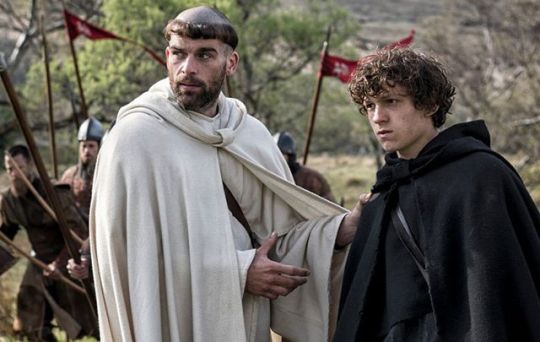
After examining the purity of heart exemplified by Brother Diarmuid, I want to take a look at the character who serves as Diarmuid’s most direct foil, Brother Geraldus (left). Geraldus enters the film appearing to be a man of faith. He is a Cistercian monk, an order following the ancient pre-Schism teachings of St. Benedict of Nursia. He also seems to be well educated in the history and workings of the Church. For all this, however, there is a disconnect between his word and his action. He does not display the integrity that the Irish monks embody, especially that of Diarmuid. His fatal flaw seems to be a kind of hubris, and a lack of love for the Other. Geraldus thinks he knows God’s will at all times, that God desires to crush “infidels”, heretics and all who oppose the sociopolitical will of the Catholic Church. More on this later.

Early on in their journey, the monks encounter a brook where Geraldus wishes to draw water. The locals warn him that it contains a fairy fort, and that those who drink the water may be cursed by the fey. Geraldus berates the Irish monks for supporting this “superstition” and performs an on-the-spot exorcism, casting out “demons” from the water in the name of Christ. In the context of humble faithfulness, this could be a positive action. However, it is done with a disdain for the lived experience and wisdom of both the local laity and Geraldus’ traveling companions, the Irish brethren. Furthermore, even at this early stage Geraldus displays his very rigid, fundamentalist understanding of faith. Anything that gets in the way of his goals (in this case, drinking the water to prove a point/prove his superior wisdom/constitution) is an enemy of Christ that must be destroyed. He upholds this militant Christianity to stroke his own ego, rather than praying in true humility and in fellowship with those around him. Later, it turns out that the stream is in fact polluted by the corpse of a dead animal further up stream. Brother Diarmuid offers healing herbs to everyone who drank the water, and the crisis is averted. This scene is not written to an ideal payoff, but there is an implication that Geraldus’ pride almost gets the party seriously ill. The Irish monks, by contrast, trust the inherited wisdom of their community and that all truth is God’s truth.

When the monks make camp with the Normans, Geraldus has a conversation with Brother Ciaran about the intentions of their new benefactors. Ciaran is very wary of partnering with these warriors from the mainland. “Surely, you are under no illusions as to what kind of men these are,” he tells Geraldus. Geraldus’ fundamentalist hubris is unable to see the wisdom in Ciaran’s caution. Indeed, Geraldus goes as far as to offer a kind of clerical blessing on the violence and conquest of the Normans. He tells Ciaran that these men need someone to intercede on their behalf at the Judgment Day, to bless them for the blood they’ve shed. In a sense, he excuses the sin of violence when he believes that it serves the greater purposes of the Church (to drive out pagans and heretics from the British Isles). A healthy theology of grace suggests that the authority entrusted to clergy is an extension of the grace of God which seeks to heal human brokenness and make all things new. Geraldus sanctioning bloodshed is a cheapening of grace, not only in terms of honor, but in terms of purpose. It misunderstands that grace is not merely forgiveness, but light and life which drives out the darkness of sin, violence and hatred. For “God is light, and in Him there is no darkness at all.” (1 Jn. 1:5).

We’ve already talked in the last section about Geraldus’ priorities when the brothers go to rescue Ciaran. As mentioned before, the sign of God’s power and the church’s authority in the relic is more important to him than the living icon of God, Geraldus’ human brother in faith. This again reveals an interest in the forms and trappings of spirituality without an investment in the true heart of it. It is missing the forest for the trees.

Towards the end of the film, Geraldus’ true nature is revealed. It is discovered that his father was condemned as a heretic, and Geraldus oversaw the preparations to have him burned at the stake. Geraldus shows no remorse for this heinous act throughout the course of the film that remains, saying that he did his duty to God and the church, and that heretics deserve no mercy. To him, God is not interested in love or mercy but in conquest, which is of course a fundamental misunderstanding of Christ who came “not to be served, but to serve” and who offered Himself up for the life of the world, trampling death not by murder but by His own death.

In the end, as mentioned before, Geraldus forces the Mute to shed blood on their behalf. He does not see this as an unfortunate necessity, but delights in it, rambling to Diarmuid about the coming conquest of the Church over the world. He is impressed by power and thinks that God is as well. The deathly nature of pride is illustrated very literally at the end of the film when Geraldus falls into the sea pursuing the relic, the instrument of power which would give him and the church the strength to conquer. Diarmuid, by contrast, values life, and is willing to relinquish all power if it will end the bloodshed that the relic has wrought. Geraldus’ role is a cautionary one, that pride often drives self-righteousness and the judgment of others. Whenever our religion and faith seem to be more focused on externals and the appearance of holiness rather than humility, gentleness and the fruits of the Spirit, we are in a state of spiritual illness. Instead, we should focus on Christ, and on His greatest commandment, to love the Lord our God, and to love our neighbor as ourselves.

Monday, June 24, 2019

"Giving It Back to God" -- Models of Faith in the Movie "Pilgrimage" -- Pt I: The Pure In Heart


So this is hopefully going to be a short series of essays looking at faith as it is portrayed in different archetypal ways by the main characters in the 2017 Irish film, “Pilgrimage.” If you haven’t seen it, go check it out. It’s fairly bloody, but emotionally and theologically rich. And it has Tom Holland in it, so that’s a plus.

If you haven’t seen the film, the premise is roughly as follows (Spoilers): a group of Irish monks in the 13th century are visited by a French Cistercian monk, who charges them with orders from the Pope to bring the monastery’s relic (a stone which was used to kill St. Matthias) to Rome. Along the way, they must deal with (eventually treacherous) Normans, Celtic brigands, and the gradual erosion of the Cistercian’s character. For this first entry, I want to discuss Tom Holland’s character, Brother Diarmuid, a young novice who serves as the film’s primary protagonist/point of view character.

In Matthew 5:8, Jesus says, “Blessed are the pure in heart, for they shall see God.” This “purity of heart” has a few different complimentary meanings. In the first place, it means an absence of evil intent or tendency. But in the broader context of the Gospel according to St. Matthew, “purity of heart” and “perfection” often have to do with a kind of consistent integrity. The idea is that the believer is encouraged to form intention and action into a unified whole. Rather than being double-minded, doing one thing while saying or thinking another, Christ desires that the heart, mind and hands are unified in thinking and doing good. There is precedent for this in the Jewish Scriptures as well. Compare, for instance, “Love the Lord your God with all your heart, all your soul and all your strength” (Deut. 6:5).

More than most characters in the film, Brother Diarmuid embodies this kind of integrity. Early in the film, Diarmuid asks his mentor, Brother Ciaran, if there has ever been peace in the Irish lands, before the coming of the Normans. Though Ciaran says no, it’s clear that he is not dismissive of Diarmuid’s question. Diarmuid truly embraces the spirit of monastic life, not to be a sacred accomplice to war or violence, but to “live at peace with everyone, so much as it depends on you” (Romans 12:18). He does not desire that the Church gain political power, but that the isles might live in peace and harmony. His desire reminds one of the words of St. Seraphim of Sarov, “Acquire the spirit of peace, and thousands around you will be saved.”

When the elder monk, Brother Ciaran, is captured by brigands along with the relic, Geraldus (the Cistercian) opines that they only have time to save the relic or Ciaran, but not both. Geraldus insists that Diarmuid save the relic, but Diarmuid instead goes directly to cut Ciaran free from the post where he is tied up. While this is certainly an act of love towards his mentor, Diarmuid’s choice also reveals an understanding of holiness. The relic is meaningful not as an abstract container of divine power, but because it serves as a reminder of the witness and holiness of St. Matthias, of his faith in the gospel to the end. Likewise, holiness in this moment is not saving a cultic object (valuable though it may be), but living the holiness of the gospel (preserving life even at the cost of valuable, holy things). Diarmuid’s priorities are to preserve life and to keep his community together against those who would seek to tear it apart for power or fortune.

Holiness is also grounded in humility. When the monks reclaim the relic towards the end of the film, Diarmuid agrees to carry it now that they’ve lost the reliquary to the brigands. Before placing the rock in his bag, he kneels and prays. There is a practical dimension to this, as the relic has been said to strike down people and that “only the pure in heart may carry it”, but I get the sense that Diarmuid’s piety is genuine here as well. There’s no words, but I imagine him asking to be made worthy to carry the stone. Diarmuid does not rush to claim ownership, to possess the relic as others in the narrative do. Rather, he accepts the responsibility of bearing it “with fear and trembling” and asks for God’s help to handle it responsibly while it is in his possession.

This humility pays off at the end of the film. Geraldus has whipped up the Mute, a presumed former Crusader traveling with them, into a blood frenzy. The Mute goes to do battle with the monks’ enemies, perhaps seeking to atone for his sins. As the monks row away from the shore, the Mute sacrifices his life to save them, and one of the monks, Brother Cathal, has been shot by an arrow. Geraldus seems unfazed by this, and begins to wax poetic about how the relic’s return to Rome will signify a new age of conquest and holy war against the “heretics and infidels”. Brother Diarmuid realizes that the relic cannot be allowed to fall into the hands of the Roman church authorities. Whether its power will serve them or not, the sense of self-righteous xenophobia displayed by Geraldus and his kin will only be heightened when they possess a legitimizing apostolic relic. The relic has protected the Irish monks during times of attack, but they have never sought to conquer nations. Only to continue to love and serve God and their community.

Diarmuid reaches for the rock. Geraldus warns him, “The relic belongs to God.” Diarmuid responds, “I’m giving it back to Him,” and after a struggle the rock is thrown into the sea, causing Geraldus to go in after it and likely drown. Diarmuid, though not intending to harm Geraldus, understands that the power represented by the relic will corrupt the purity of his church’s faith. Rather than being an asset to the witness of the gospel, it will serve as a symbol of pride and disdain for those seen as “lesser than.” And no relic, no matter how sacred, is worth that cost. Diarmuid knows this, because he is deeply in touch with what it means to be a man of faith. He is a novice in the monastic order, and knows little of scholastic theology. But he shows love for his kinsmen, and a deep intuition of what God desires of humanity. Whenever he acts, he refrains from violence where possible. Where situations force him to use violence, he uses it only to protect, and there as little as possible.* In all things, his intention and his action flow into each other, and all for the purposes of love and for peace. He is one of “the pure in heart” and at the end of the film, the final shot reveals a quasi-celestial light shining through the Irish cloud layer on Diarmuid’s boat. It seems that in the film’s language, he has indeed, “seen God.”

*Note: We will talk more about monasticism and absolute nonviolence later, in my essay on Brother Ciaran. For now, it suffices to say that Diarmuid eschews violence whenever possible, and only acts in self-defense with non-lethal force in the instances he does fight.